


Ṣàngó occupies a distinctive position in Yoruba religious and historical traditions. He is remembered as a former Alaafin and revered as the òrìṣà associated with thunder and lightning.
The precise historical details of Ṣàngó’s reign remain debated. Yoruba oral traditions and royal genealogies differ on his position in the succession, and the transition from a remembered king to a divinity belongs partly to religious belief and cultural memory.
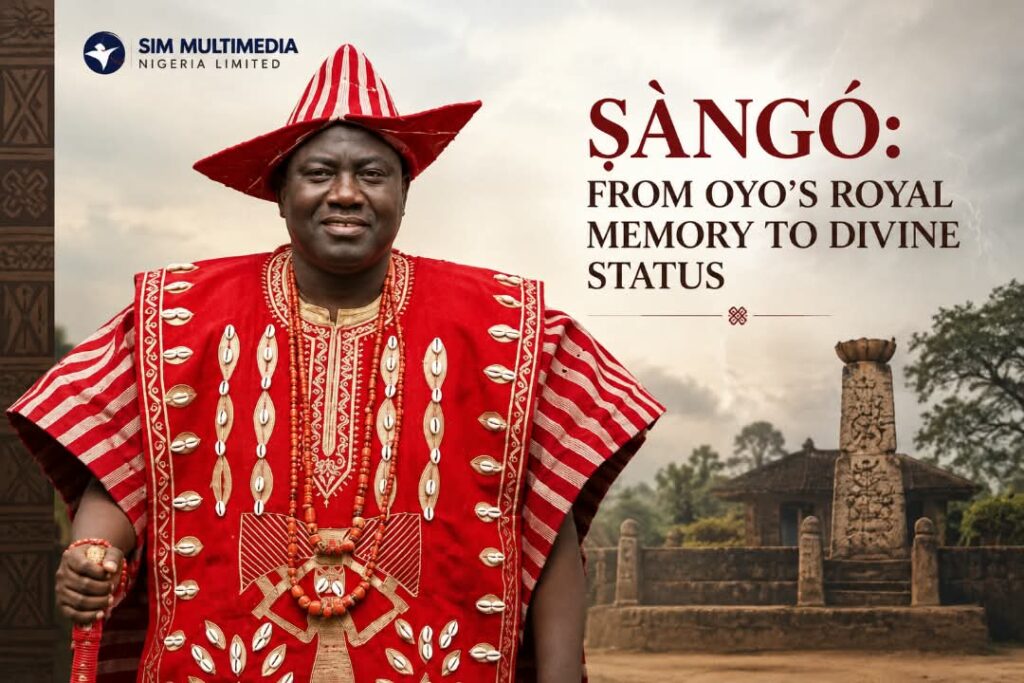
Historian S. O. Babayemi, in his 1988 study Sango Traditions and Cult Organisation in Oyo, examined how Ṣàngó worship became connected with Oyo’s political and religious institutions. His research highlights the close relationship between the spiritual authority attributed to Ṣàngó and the legitimacy of the Alaafin.
This relationship is central to understanding why Ṣàngó’s legacy remains important to Oyo. His significance extends beyond worship alone; it forms part of the historical traditions through which the Alaafin institution has understood and expressed its royal identity.
THE ALAAFIN AND THE RITES AT KOSO
One of the most important traditions associated with Koso concerns the installation of a new Alaafin.
UNESCO’s documentation of the Sango Festival of Oyo describes the Koso shrine as a sacred location connected with the rites performed for the king-elect. The documentation identifies the Mọ̀gbà Kòṣò, the chief priest associated with Ṣàngó at Koso, as a custodian of important ritual responsibilities and traditions surrounding the installation of the Alaafin.
These practices demonstrate the continuing relationship between the throne and the religious institution associated with Ṣàngó. The coronation tradition is not simply a public ceremony; it carries spiritual and cultural meaning for those who maintain and participate in it.
Some elements of the rites are restricted to authorised participants. Their significance should therefore be reported respectfully, without claiming knowledge of confidential practices or presenting customary beliefs as independently verified historical facts.
The central point is clear: Koso occupies an important place in the traditional understanding of Alaafin installation, and the Mọ̀gbà Kòṣò holds a recognised role within that religious tradition.
WHY ṢÀNGÓ MATTERS TO THE ALAAFIN INSTITUTION
The association between Ṣàngó and the Alaafin provides insight into the way political and spiritual authority interacted in precolonial Oyo.
In many traditional societies, kingship was sustained not only through political power and succession but also through ceremonies, ancestral traditions and religious institutions. Oyo’s Ṣàngó tradition offers a documented example of this relationship.
Babayemi’s research discusses the role of Ṣàngó cult organisations in Oyo and their relationship with the spiritual well-being and political authority of the state. The study helps explain why Ṣàngó’s religious status became closely associated with the position of the Alaafin.
This does not mean that every historical decision made by an Alaafin was determined by religious authorities, or that the precise relationship between the palace and the Ṣàngó cult remained unchanged throughout history. It means that religious traditions formed an important part of the cultural and political framework within which Oyo’s kingship was understood.
Koso consequently represents more than a shrine. It is a place through which the relationship between royal succession, spiritual tradition and Oyo’s collective identity is remembered and maintained.
KOSO AND THE CONTINUITY OF OYO’S HERITAGE
The history of Oyo has passed through significant political changes, including the decline of the Old Oyo Empire and the later reconstruction of the kingdom. Yet traditions associated with Ṣàngó have continued to hold cultural importance.
UNESCO’s 2023 inscription of the Sango Festival of Oyo recognises the living character of this heritage. The festival brings together devotees and other participants through ritual observances, storytelling, chanting, drumming and dancing. UNESCO describes it as an expression of shared identity and social cohesion within the Oyo community.
The festival also demonstrates how heritage survives through practice and transmission. Knowledge is maintained by religious custodians and elders, while younger generations encounter the traditions through participation, observation and instruction.
Koso’s place in this wider tradition makes the preservation of its religious and historical significance important to Oyo. Protecting such heritage requires respect for sacred customs, responsible documentation and the preservation of relevant historical sites.
PRESERVING THE LEGACY OF KOSO
Koso’s heritage deserves careful historical documentation and appropriate conservation. Its importance arises from the convergence of religious tradition, royal history and the continuing cultural life of Oyo.
Oral accounts remain essential to understanding how the community interprets the site. Archaeological research and documentary evidence, meanwhile, can help clarify the history of settlement in the area and distinguish material findings from later interpretations.
These sources should complement rather than automatically replace one another. Oral traditions explain the meanings communities attach to places and institutions, while archaeology and written records can provide additional evidence about chronology, settlement and historical change.
For Oyo, the task is to preserve Koso as a significant part of its heritage while ensuring that historical claims are presented accurately and that sacred practices are treated with respect.
CONCLUSION: KOSO AS A LINK BETWEEN ṢÀNGÓ AND THE ALAAFIN
Koso occupies a significant place in Oyo’s cultural history because of its association with Ṣàngó and the traditional rites surrounding the Alaafin institution.
The site brings together two enduring aspects of Oyo’s heritage: the memory of Ṣàngó as a royal figure and his veneration as a divinity associated with thunder and lightning. Through the traditions maintained at Koso, this relationship continues to hold meaning for the royal institution, religious custodians and the wider community.
The historical details of Ṣàngó’s life remain intertwined with oral tradition and religious belief. Nevertheless, the importance of the Ṣàngó tradition in Oyo’s cultural and royal life is supported by scholarly research and UNESCO’s documentation of the festival.
Koso is therefore an important part of Oyo’s living heritage: a sacred place where the memory of Ṣàngó, the traditions of kingship and the continuing identity of the Alaafin institution meet.