


The supremacy of the Alaafin of the Oyo Empire occupies a significant place in the political and cultural history of the Yoruba people. At the height of the empire’s influence, the Alaafin stood at the apex of its royal hierarchy, embodying the sovereignty of the state and presiding over an imperial system that exercised considerable political influence across parts of West Africa.
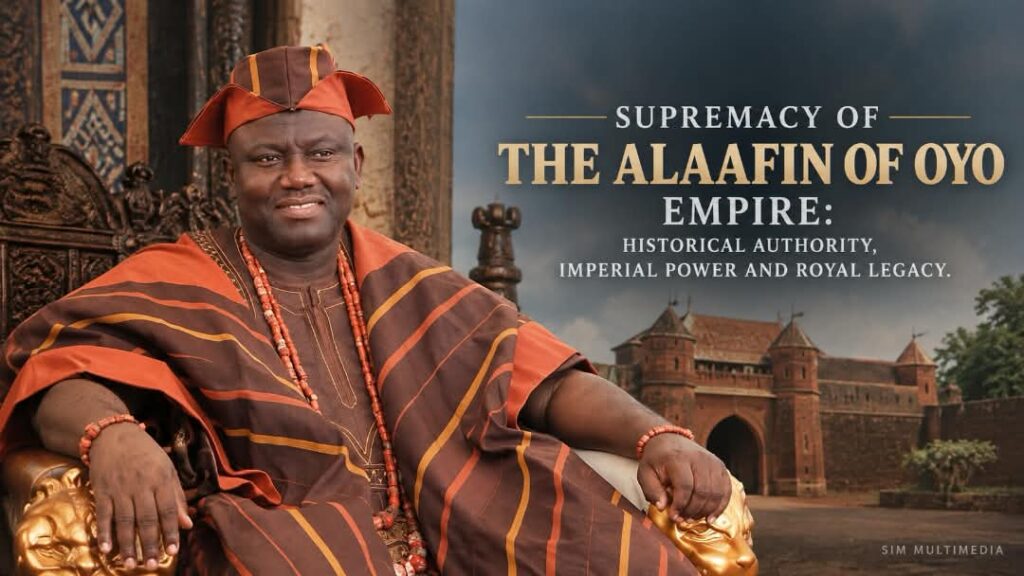
The significance of the Alaafin’s throne must be understood through two distinct dimensions: imperial authority and cultural authority. Imperial authority concerns the historical powers associated with the governance and administration of the Oyo Empire, while cultural authority concerns the royal institution’s enduring place in Yoruba traditions, identity and heritage.
Although these dimensions reinforce the historical significance of the throne, they are not identical. Imperial supremacy is examined through political institutions, military organisation and territorial influence; cultural supremacy is understood through tradition, symbolism, royal dignity and the preservation of collective heritage.
Together, these dimensions explain why the institution of the Alaafin remains an important subject in African history.
PART ONE: THE IMPERIAL AUTHORITY OF THE ALAAFIN
- The Alaafin at the Apex of Imperial Government
The Alaafin occupied the highest royal position within the political hierarchy of the Oyo Empire. The throne stood at the centre of the imperial system, representing the sovereignty of the state and providing the institutional focus for its political administration.
During the empire’s period of expansion, particularly in the seventeenth and eighteenth centuries, Oyo developed into a major regional power. The Alaafin’s position was associated with the conduct of state affairs, the coordination of imperial interests, diplomatic relationships and the maintenance of political order.
The authority of the throne extended beyond the capital through administrative arrangements and relationships with territories that acknowledged Oyo’s superior political influence.
The Alaafin’s imperial standing was therefore not merely ceremonial. It was connected to the operation of a political system that enabled Oyo to exercise authority over an extensive regional sphere.
- Territorial Influence and Imperial Supremacy
One of the principal expressions of Oyo’s imperial power was its ability to influence political communities beyond its immediate territory. Relationships with subordinate territories could involve tribute, diplomatic obligations, military pressure and recognition of Oyo’s political interests.
Tribute was particularly important because it provided resources to the imperial centre and expressed the relationship between Oyo and territories acknowledging its authority.
However, the degree of control varied across territories. Some maintained considerable internal autonomy, while others were more closely connected to Oyo’s political arrangements. Consequently, the empire should not be understood as a uniformly administered modern state.
This distinction notwithstanding, the Alaafin occupied the apex of the imperial royal hierarchy. The throne represented the central authority around which Oyo’s political relationships and imperial interests were organised.
- The Alaafin and the Institutions of Government
The imperial authority of the Alaafin operated within an established political framework. The Oyo Mesi, a council of senior chiefs, played a significant role in the administration of the state and in the constitutional relationship between the throne and the governing elite.
Historical scholarship shows that the Alaafin’s authority could be constrained by established conventions and political institutions. The existence of these checks does not negate the Alaafin’s position as the highest royal authority within the imperial hierarchy; rather, it demonstrates that Oyo possessed a complex system of government.
In his article, “The Constitutional Troubles of Ọyọ in the Eighteenth Century,” published in 1971, historian Robin Law examines the political tensions that shaped the relationship between the Alaafin and the Oyo Mesi.
The historical importance of the throne therefore lies in both its elevated position and its role within the institutional machinery of the empire.
- Military Organisation and Imperial Power
Military organisation was another important foundation of Oyo’s historical influence. The empire’s capacity to mobilise armed forces, defend its interests and undertake campaigns contributed to its regional standing.
The Alaafin occupied a central position within the imperial political and military order. The state’s ability to maintain its authority depended on military resources, administrative coordination and the officials responsible for carrying out imperial decisions.
Military strength reinforced the empire’s political relationships and helped sustain its influence during periods of expansion. It also demonstrated that imperial authority depended on practical institutions and resources, not royal prestige alone.
The Alaafin’s imperial supremacy must therefore be understood within the wider framework of Oyo’s military, political and administrative capabilities.
PART TWO: THE CULTURAL AUTHORITY OF THE ALAAFIN
- The Alaafin as a Custodian of Yoruba Heritage
Beyond the political history of the empire, the Alaafin’s throne holds enduring significance as a royal institution associated with the preservation of Oyo’s traditions and cultural identity.
Cultural authority differs from territorial or military power. It is expressed through inherited customs, royal ceremonies, palace protocols, oral traditions and the collective recognition of the historical importance of the throne.
The Alaafin’s cultural significance is rooted in the continuity of the institution across generations. The throne serves as a symbol of Oyo’s historical identity and provides a connection between the traditions of the past and the cultural life of the present.
This heritage cannot be measured solely by the territorial reach of the former empire. Cultural authority may endure through tradition, memory and institutional continuity even as political systems change.
- Royal Dignity, Tradition and the Meaning of the Throne
The Alaafin’s cultural authority is reinforced by the dignity and ceremonial traditions attached to the office. Royal protocols, palace customs and traditional expressions of respect communicate the importance attributed to the throne within Oyo’s cultural heritage.
The expression Ikú Bàbá Yèyé is associated with the dignity of the Alaafin and reflects the elevated status traditionally accorded to the office.
Such expressions belong to the cultural and ceremonial language of Yoruba kingship. They communicate reverence and royal prestige, but their cultural meaning should be distinguished from the specific constitutional powers historically exercised by the throne.
The distinction is important: cultural reverence concerns the status and symbolism of the institution, while imperial authority concerns the political powers and governmental relationships associated with the Oyo state.
Both contribute to the historical significance of the Alaafin, but each must be understood on its own terms.
- Ancestral Continuity and the Preservation of Royal Legacy
The Alaafin’s cultural authority also rests on the preservation of historical memory. Oral traditions, royal genealogies, palace customs and historical accounts have contributed to the transmission of Oyo’s heritage across generations.
Samuel Johnson’s The History of the Yorubas, published in 1921, remains an important source for studying the history and traditions associated with Oyo. Its accounts are most useful when considered alongside later historical research and examined critically in relation to the nature of oral tradition.
The continuity of the Alaafin institution connects contemporary cultural heritage with the historical experience of the Oyo Empire. It also places responsibility on historians, traditional institutions and media organisations to document the past carefully and distinguish established historical evidence from claims that require further verification.
For this reason, the cultural legacy of the Alaafin deserves serious attention not only as a subject of royal prestige but also as part of the wider history of Yoruba civilisation.
IMPERIAL AUTHORITY AND CULTURAL AUTHORITY: TWO DISTINCT DIMENSIONS
The supremacy of the Alaafin is best understood by recognising the distinction between the political authority associated with the former empire and the cultural significance of the royal institution.
Imperial authority concerns the Alaafin’s historical position within Oyo’s system of government, including political administration, military organisation, diplomacy and relationships with territories under imperial influence.
Cultural authority concerns the throne’s place in Yoruba heritage, royal traditions, ancestral continuity, ceremonial dignity and collective historical identity.
Imperial authority is principally examined through historical institutions and the exercise of political power. Cultural authority is examined through traditions, social recognition, historical memory and the continuing significance of the royal institution.
The two dimensions are related because the Alaafin’s cultural stature is partly informed by the historical achievements and influence of the Oyo Empire. Nevertheless, cultural prestige should not automatically be interpreted as proof of unlimited political jurisdiction in the present day.
Maintaining this distinction makes the case for the Alaafin’s historical supremacy more precise, credible and defensible.
Conclusion: The Enduring Supremacy and Legacy of the Alaafin
The supremacy of the Alaafin of the Oyo Empire rests on a historical legacy that must be examined through both imperial authority and cultural authority.
In the imperial sphere, the Alaafin occupied the apex of Oyo’s royal hierarchy and was central to the political institutions, military organisation and territorial relationships through which the empire exercised its influence.
In the cultural sphere, the Alaafin’s throne represents royal dignity, historical continuity and the preservation of traditions associated with Oyo’s heritage.
These are distinct but interconnected dimensions of the institution’s significance. Imperial authority explains the historical position of the throne within the machinery of government; cultural authority explains its enduring importance within the traditions and identity of the Yoruba people.
The Alaafin’s historical legacy therefore extends beyond the splendour of the palace or the prestige of royal titles. It encompasses the political history of an influential African empire and the cultural traditions through which its royal institution continues to be remembered.
The imperial authority of the Alaafin belongs to the history of Oyo’s political power; the cultural authority of the throne belongs to the continuing heritage of Oyo. Together, they provide the foundation for understanding the historical supremacy and enduring legacy of the Alaafin.