

By Sangodare Elisha Oyeyinka
The more I investigate Yoruba history, the more I realise that we may have accepted certain historical narratives for so long that we have stopped asking the questions that truly matter.
One question, in particular, continues to interest me:
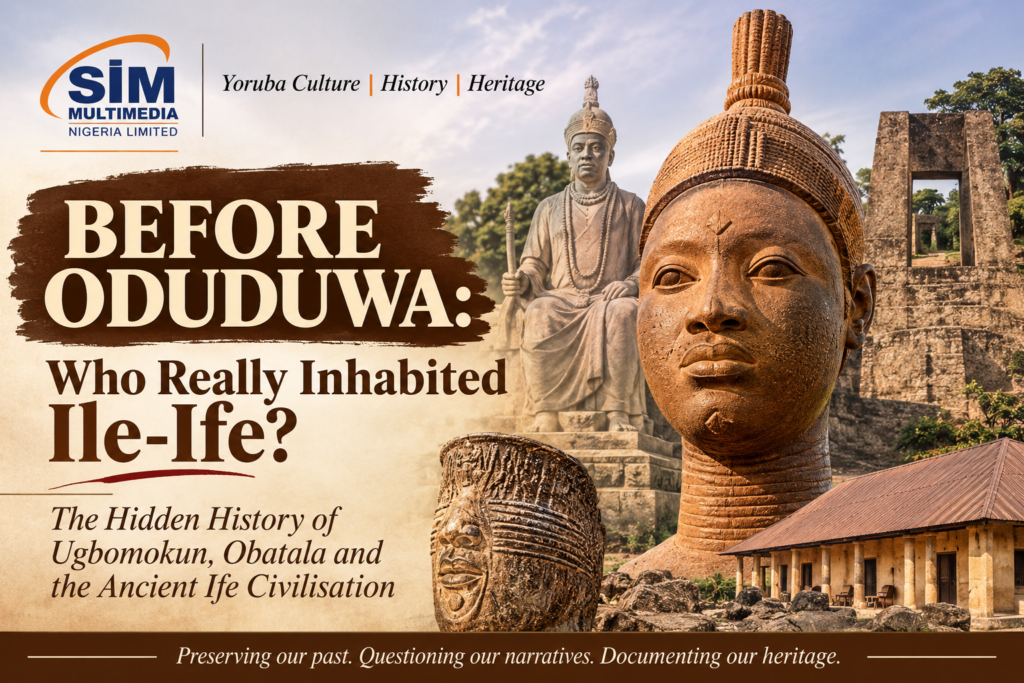
WAS ILE-IFE ALREADY AN ESTABLISHED CIVILISATION BEFORE THE ARRIVAL AND POLITICAL ASCENDANCY OF ODUDUWA?
I believe this question deserves more attention than it currently receives.
For generations, the story of Oduduwa has dominated the discussion about the origin of Ile-Ife and Yoruba civilisation. He is celebrated as the progenitor of Yoruba kingship and an ancestor of numerous traditional ruling houses.
But does acknowledging Oduduwa’s importance mean that we must assume that Ile-Ife had no inhabitants, no religious institutions and no established traditional authorities before him?
Certainly, that assumption deserves to be challenged.
UGBOMOKUN: WAS THERE AN ILE-IFE BEFORE ODUDUWA?
One of the most interesting historical arguments I have encountered concerns Ugbomokun, also known as Igbomokun in some accounts.
In his 2024 inaugural lecture at Osun State University, Professor Olukoya Ogen examined the traditions of the Ugbo people and their relationship with pre-Oduduwa Ile-Ife.
His research discusses the possibility that the Ugbo were among the indigenous inhabitants of ancient Ife and that Ugbomokun was associated with the settlement before the emergence of Oduduwa’s political tradition.
This is not an insignificant historical submission.
It raises questions that Yoruba historians should be willing to confront:
Who were the original inhabitants of this ancient settlement? What political and religious institutions did they maintain? Who exercised authority before the emergence of Oduduwa’s dynasty? What happened to their traditional institutions when political power changed?
These questions cannot be answered simply by repeating that Oduduwa founded Ile-Ife.
A civilisation can exist before the dynasty that later becomes dominant. The history of a people should never be reduced to the genealogy of their present ruling institutions.
ODUDUWA: FOUNDER OF A DYNASTY OR ARRIVAL INTO AN EXISTING CIVILISATION?
Some Yoruba oral traditions describe an earlier religious and political order associated with Obatala and the Ugbo, followed by the emergence of Oduduwa’s political authority.
This raises the possibility that what is popularly described as the founding of Ile-Ife may, in another historical interpretation, represent a change in political authority within an already inhabited settlement.
Professor Ogen’s research gives this interpretation an important academic platform.
Similarly, Emmanuel Adebanjo Akorede’s 1986 doctoral thesis at Obafemi Awolowo University examined the integration of different communities in Ile-Ife.
Robin Law’s influential 1973 article, The Heritage of Oduduwa: Traditional History and Political Propaganda among the Yoruba, also demonstrates the importance of examining Oduduwa traditions in their political and historical contexts.
We must understand something fundamental: questioning whether Oduduwa was the first inhabitant of Ile-Ife does not diminish his place in Yoruba history.
It simply means that his political and ancestral importance should not prevent us from investigating the people and institutions that may have preceded him.
OBATALA AND THE OBALUFON DYNASTY: THE HISTORY THAT NEEDS MORE ATTENTION
Another area that deserves serious investigation is the relationship between Obatala, the Obalufon dynasty and the early religious institutions of Ile-Ife.
Who was the Olufe associated with the Obatala tradition? What was the position of the Obalufon lineage? How did the earlier religious authorities relate to the political institutions associated with Oduduwa?
These are not questions to be answered through sentiment or institutional rivalry.
They require the examination of original Ifa verses, royal genealogies, historical records and the oral traditions preserved by the relevant priesthoods and traditional families.
We must be careful not to erase one ancestral institution simply to give another an exclusive place in the history of our civilisation.
Yoruba history is much bigger than a competition over who should receive the greatest historical recognition.
THE NILE VALLEY QUESTION: WHAT DO WE ACTUALLY KNOW?
There are also claims connecting Yoruba ancestral divinities with the Nile Valley.
J. Olumide Lucas, in his 1942 publication The Religion of the Yorubas, explored possible connections between Yoruba religious traditions and ancient Egyptian civilisation.
This remains an important contribution to the history of comparative Yoruba religious studies.
However, we must distinguish between cultural similarities, historical contacts and proven geographical origins.
There is presently no conclusive evidence establishing the Nile Valley as the original homeland of Oduduwa, Obatala, Ogun, Sango, Orunmila and the entire Yoruba pantheon.
The Yoruba language belongs to the Niger-Congo family, and linguistic research places its deeper historical roots within the African linguistic landscape south of the Sahara.
The possibility of ancient movements and cultural exchanges should remain open to investigation, but we must not present an unproven migration theory as established history.
THE IJEBU CONNECTION: ANOTHER CHAPTER TO INVESTIGATE
I have also encountered accounts suggesting that ancient Ijebu authorities played a protective role in the movement of Ife priesthood families and sacred objects through Ekiti before their eventual settlement in the Ife region.
Some accounts further connect these movements with the ancient Ugbo and Obatala traditions.
This is a fascinating proposition.
But where are the original records? Which Ijebu authorities were involved? Which families were relocated? What evidence connects the proposed settlements? Which Ifa verses preserve these accounts?
These questions deserve answers.
The historical relationship between Ijebu and Ife should not be ignored, but neither should a specific migration operation be declared an established fact without corroborating evidence.
THE ATIBA AND ORANMIYAN QUESTION
Another submission suggests that an Atiba prince, acting on an Oranmiyan mission, led Ijebu warriors into ancient Ife against certain dissident groups.
This account also requires chronological clarification.
Samuel Johnson’s The History of the Yorubas (1921) discusses Prince Atiba within the nineteenth-century history of Oyo and the establishment of New Oyo.
Was the Atiba mentioned in the account the same historical prince, or another individual?
If it was the nineteenth-century Prince Atiba, how does his alleged operation fit into the much earlier history of Ile-Ife?
We cannot afford to confuse personalities, generations and historical periods merely because they share a name.
WE MUST STOP CONFUSING HISTORICAL INVESTIGATION WITH DISRESPECT
One unfortunate problem in the discussion of Yoruba history is the tendency to interpret every alternative historical argument as an attack on a particular monarch, dynasty or community.
That approach does not help us.
Oduduwa deserves his place in Yoruba history. Obatala deserves his place. The Obalufon dynasty, the Ugbo, the Olugbo, the Ooni, the Alaafin and other traditional institutions all deserve to have their histories properly documented and examined.
Recognising the antiquity of one community does not require us to diminish another.
Equally, investigating the historical importance of a dynasty should not require us to silence traditions that predate it.
Our ancestors did not leave us their heritage so that we could turn historical research into a permanent contest of superiority.
FIVE LESSONS I HAVE LEARNT FROM INVESTIGATING YORUBA HISTORY
- A ruling dynasty is not necessarily the beginning of a civilisation. A community may have existed for generations before the emergence of the dynasty that eventually governed it.
- Oral traditions are historical resources. They deserve documentation, comparison and serious investigation, not automatic acceptance or dismissal.
- Historical claims require evidence. A respected personality making a submission does not automatically make that submission historically established.
- Our traditional institutions should not be enemies of historical research. Their records, genealogies, sacred traditions and custodians are important resources for reconstructing our past.
- We must have the courage to correct our historical understanding. If credible evidence challenges what we previously believed, intellectual honesty requires us to examine it.
MY POSITION: LET US INVESTIGATE THE ILE-IFE THAT EXISTED BEFORE ODUDUWA’S POLITICAL ASCENDANCY
I am not interested in defending one historical personality by erasing another.
I am interested in understanding what actually happened.
Was Ugbomokun an earlier name associated with ancient Ife? Were the Ugbo among its indigenous inhabitants? What was the position of Obatala and the Obalufon dynasty? What role did Ijebu and other neighbouring communities play in the development of the ancient settlement?
And what can archaeology, linguistics, historical documents and original oral traditions tell us about these questions?
These are the issues that deserve our attention.
We must also resist the temptation to replace an unverified Oduduwa-centred narrative with an equally unverified Nile Valley migration narrative.
The purpose of historical research is not to manufacture a more convenient past. It is to discover as much of the truth as the available evidence allows.
I strongly believe that the history of Ile-Ife deserves a deeper investigation, particularly the traditions surrounding Ugbomokun, the Ugbo, Obatala and the early religious and political institutions of the ancient city.
Our history is too precious to be monopolised by assumptions, political interests or unquestioned repetitions.
BEFORE WE ASK WHO FOUNDED ILE-IFE, WE MUST FIRST BE COURAGEOUS ENOUGH TO ASK WHO WAS THERE BEFORE HIM.
That is the kind of historical conversation our generation should be having.
REFERENCES FOR FURTHER RESEARCH
- Ogen, Olukoya (2024). Reconstructing a Silenced Past: Echoes of Revisionism and Counter Hegemonic History. Osun State University.
- Law, Robin (1973). The Heritage of Oduduwa: Traditional History and Political Propaganda among the Yoruba. Journal of African History, 14(2), 207–222.
- Law, Robin (1984). How Truly Traditional Is Our Traditional History? The Case of Samuel Johnson and the Recording of Yoruba Oral Tradition. History in Africa, 11, 195–221.
- Johnson, Samuel (1921). The History of the Yorubas.
- Wyndham, John (1921). Myths of Ife.
- Akorede, Emmanuel Adebanjo (1986). A Geographic Analysis of the Pattern of Integration between the Discrete Communities in Ile-Ife. Obafemi Awolowo University.
- Babalola, A. et al. (2017). Ile-Ife and Igbo Olokun in the History of Glass in West Africa. Antiquity, 91(357), 732–750.
- Lucas, J. Olumide (1942). The Religion of the Yorubas.
- Olupona, Jacob K. (1993). The Study of Yoruba Religious Tradition in Historical Perspective. Numen, 40(3), 240–273.
SANGODARE ELISHA OYEYINKA
SIM MULTIMEDIA NIGERIA LIMITED
Yoruba Culture | History | Heritage
Preserving our past. Questioning our narratives. Documenting our heritage.