

There is something I have come to appreciate as I continue to study, investigate and discuss Yoruba history: we must never allow present-day political arrangements to become the foundation upon which we judge our historical institutions.
History did not begin with the creation of the Western Region. It did not begin with the division of Nigeria into states. And it certainly did not begin with today’s disagreements about which traditional ruler should be recognised above another.
There was an Oyo Empire. There was an imperial political system. There was a period when the Alaafin stood at the centre of a powerful government that influenced the political affairs of numerous kingdoms and territories.
Yet, whenever the historical position of the Alaafin is discussed, some people approach the subject as though Oyo’s history has always been restricted to the geographical boundaries of present-day Oyo State.
That is a misunderstanding of our history.
I have come to realise that if we genuinely want to understand the political history of Yorubaland, we must first understand the rise, expansion, authority and eventual disintegration of the Oyo Empire.
And one fact must remain clear throughout this discussion:
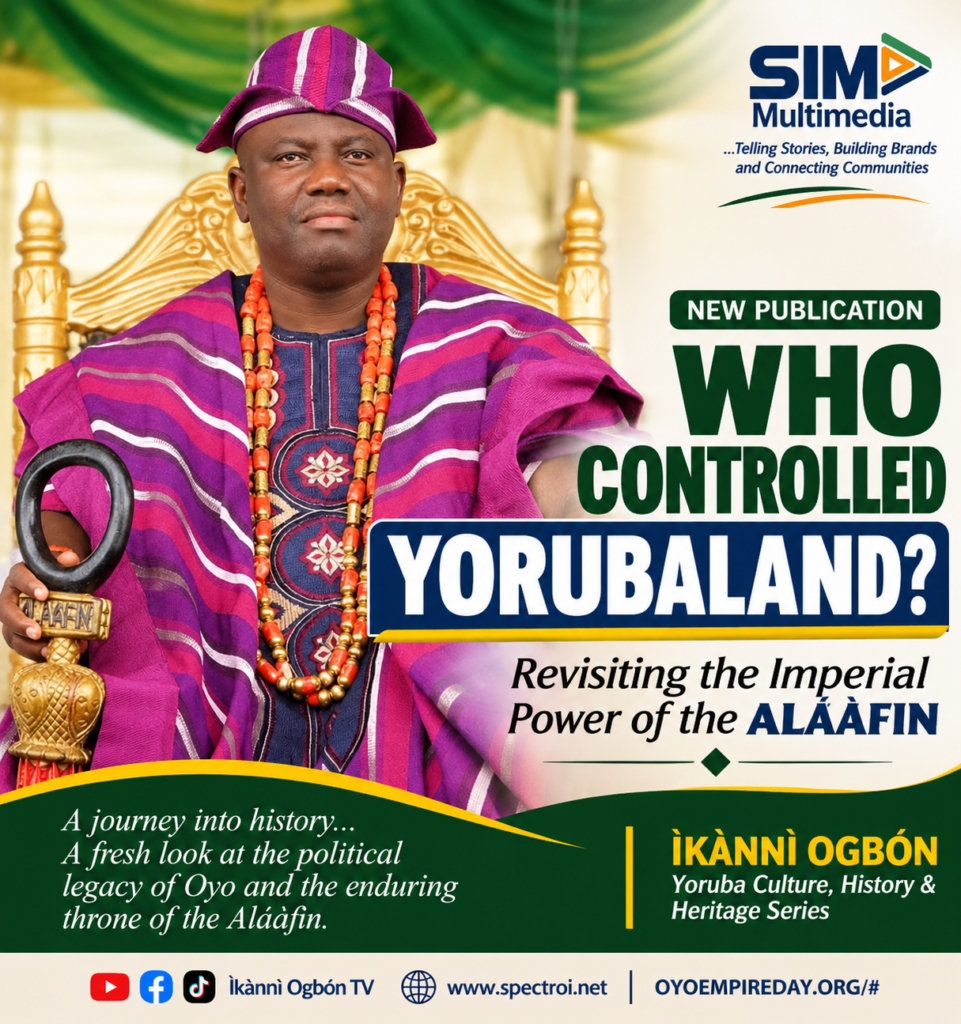
THE OYO EMPIRE COLLAPSED, BUT THE ALÁÀFIN THRONE SURVIVED.
OYO WAS NOT JUST ANOTHER YORUBA KINGDOM
One of the most important historical works I have encountered is Robin Law’s The Oyo Empire, c.1600–c.1836: A West African Imperialism in the Era of the Atlantic Slave Trade, published in 1977.
Law’s research documents how Oyo developed into the largest and most powerful kingdom in the Yoruba area during the seventeenth and eighteenth centuries.
This was not an ordinary kingdom exercising authority over a few neighbouring towns.
Oyo developed a sophisticated imperial system supported by military organisation, diplomacy, trade, taxation and relationships with subordinate territories.
The Alaafin occupied the centre of that system.
What does this mean?
It means that when we discuss the historical authority of the Alaafin, we must look beyond the immediate territory of Oyo-Ile.
The empire’s influence extended into territories that today fall within different Nigerian states and neighbouring countries.
This is a historical fact that deserves more attention.
HOW FAR DID THE POLITICAL INFLUENCE OF OYO EXTEND?
One particularly revealing historical account is found in Governance and Ritual Sovereignty at the Niger-Benue Confluence, a scholarly study of the political and cultural history of the region.
It documents Oyo’s expansion between approximately 1726 and 1730, including its extension into the Kingdom of Dahomey.
By around 1750, Oyo’s imperial territory and sphere of influence included the whole of Egba and Egbado, parts of Igbomina, Ajase and Weme, and parts of Nupe and Borgu.
Dahomey also became a tributary state under Oyo’s imperial influence.
Think about the geographical implications.
Some of these territories are outside present-day Oyo State. Some are outside present-day Nigeria.
This is why I find it difficult to accept arguments that attempt to measure the historical position of the Alaafin using only today’s administrative boundaries.
The political influence of the Oyo Empire was considerably wider.
However, we must understand that these relationships were not identical. Some territories were incorporated more directly, while others retained their local rulers and internal government under varying forms of Oyo’s overlordship.
That distinction is important because an empire does not necessarily remove every local king. It can retain local kings while establishing superior imperial authority.
A kingdom can have its own Oba and still acknowledge an imperial authority above it.
That was one of the important characteristics of Oyo’s imperial political arrangements.
WHO HISTORICALLY CONTROLLED YORUBALAND POLITICALLY?
This is perhaps the most important question in this entire discussion.
When we examine the historical political development of the Yoruba region, we must acknowledge that Ile-Ife and Oyo occupied different positions at different periods.
Ile-Ife had exceptional ancestral, cultural, religious and political significance in the earlier development of Yoruba civilisation.
However, as political and commercial conditions changed, Oyo rose to become the dominant imperial power.
Ayodeji Ogunnaike, in his 2022 Oxford Academic publication Precolonial Yoruba States, explains that Ile-Ife enjoyed a central position between approximately 1000 and 1500 CE. Subsequently, Oyo began to eclipse Ile-Ife in regional prestige and political power, eventually establishing the largest empire in the West African tropical forest.
That historical development is important.
It helps us distinguish between the historical significance of Ile-Ife and the imperial political authority exercised by Oyo.
Samuel Johnson’s The History of the Yorubas (1921), particularly Chapter IV on government, also discusses the historical system of overlordship in which distant territories maintained varying degrees of independence while acknowledging a superior authority.
Johnson identifies Oyo as the central political government in the system he describes.
THE ALÁÀFIN AND THE OTHER YORUBA TRADITIONAL FATHERS
I do not believe that recognising the historical political authority of the Alaafin requires us to diminish the importance of other Yoruba traditional institutions.
The Ooni of Ife occupies an exceptional position in Yoruba ancestral and spiritual traditions.
The Aláké, Awujale, Olubadan, Soun, Ewi, Owa, Aláàfin’s provincial authorities and other traditional rulers each have histories that deserve proper documentation.
But we must also be able to discuss the historical political hierarchy that existed during Oyo’s imperial period.
There is a difference between spiritual significance, ancestral seniority, political influence, imperial sovereignty and present-day constitutional authority.
These things should not be mixed together simply to win arguments.
Oyo’s political dominance during its imperial period is supported by historical scholarship. Ile-Ife’s ancestral and spiritual significance is equally recognised in Yoruba historical traditions.
We can recognise both without creating unnecessary rivalry.
Our traditional fathers should be respected, but respect must not become an excuse for historical distortion.
WHEN THE EMPIRE COLLAPSED: WHAT HAPPENED TO THE ALÁÀFIN?
This is where I believe the conversation becomes even more interesting.
The Oyo Empire did not collapse because one morning somebody decided that it should no longer exist.
Its decline followed years of internal political struggles, competition for power, provincial rebellion, military setbacks and changing economic conditions.
Robin Law’s 1971 research, The Constitutional Troubles of Oyo in the Eighteenth Century, examines the conflict between the Alaafin and the Oyo Mesi, particularly the powerful Basorun.
The study discusses the seizure of power by Basorun Gaha in 1754, the Alaafin’s recovery of power in 1774, and the political upheaval around 1796 that contributed to the empire’s disintegration.
Provincial rulers increasingly began to assert their independence as the central government weakened.
By the early nineteenth century, the old Oyo imperial structure had disintegrated.
B.A. Agiri’s Early Oyo History Reconsidered (1975) also examines the collapse and the difficulties involved in reconstructing Oyo’s early history.
But here is the point I want every reader to understand:
THE FALL OF THE OYO EMPIRE DID NOT MEAN THE DEATH OF THE ALÁÀFIN INSTITUTION.
An empire is a political and territorial structure. A throne is an institution of kingship.
The loss of imperial territories does not automatically extinguish the monarchy that once governed them.
The Alaafin institution continued through successive reigns, even though the political circumstances surrounding it changed dramatically.
That is the historical continuity we must appreciate.
The empire was no longer what it used to be, but the throne remained.
BEFORE WESTERN REGION POLITICS, THERE WAS THE OYO IMPERIAL SYSTEM
We must also understand the difference between the collapse of the Oyo Empire and the later political arrangements introduced by colonial and postcolonial governments.
The empire had already disintegrated before the creation of the Western Region.
Therefore, it would be historically inaccurate to blame Western Region politics for the original collapse of the Oyo Empire.
However, colonial rule and subsequent governmental structures changed the environment in which Yoruba traditional rulers operated.
The old imperial political arrangement was no longer in place.
Modern Nigeria introduced different administrative boundaries, state governments and traditional councils.
Today, the traditional institutions of Oyo, Ogun, Osun, Ondo, Ekiti and Lagos operate within different governmental arrangements.
But let us ask an important question:
Do modern political boundaries erase the historical relationships that once existed among these territories?
Certainly not.
The creation of modern states cannot erase the historical influence of Oyo over territories that once formed part of its imperial sphere.
Equally, the historical position of the Alaafin should not be confused with a present-day constitutional power to appoint, remove or administer every Yoruba Oba.
Historical supremacy and contemporary legal jurisdiction are two different questions.
We must be bold enough to understand both.
THE THRONE IS BIGGER THAN THE EMPIRE THAT ONCE SURROUNDED IT
One lesson I have learned from studying historical monarchies is that their importance cannot always be measured by the size of their former territories.
The Alaafin institution has witnessed different political eras:
- The early development of the Oyo kingdom.
- The expansion of the Oyo Empire.
- The height of Oyo’s imperial power.
- The internal political crises and disintegration.
- The nineteenth-century wars and political transformations.
- Colonial administration.
- Modern Nigerian governance.
Through these different periods, the institution continued.
This is not a small part of Yoruba history.
It is a significant historical legacy.
The Alaafin’s imperial political authority should therefore be examined within the broader history of the Yoruba people and the development of West African political civilisation.
WHAT SHOULD OUR GENERATION LEARN?
I believe there are important lessons here.
FIRST: KNOW YOUR HISTORY BEFORE ENTERING INTO ARGUMENTS.
Do not build historical arguments solely on what somebody said at a gathering or posted on social media. Read the books. Examine the records. Compare oral traditions with academic research.
SECOND: DO NOT USE TODAY’S POLITICAL BOUNDARIES TO REWRITE YESTERDAY’S HISTORY.
Oyo’s historical influence extended beyond present-day Oyo State. That fact deserves proper recognition.
THIRD: UNDERSTAND THE DIFFERENCE BETWEEN AN EMPIRE AND A THRONE.
An empire can collapse while its royal institution survives. The Alaafin institution is an important example of that historical continuity.
FOURTH: DO NOT CONFUSE RESPECT WITH HISTORICAL SILENCE.
Respecting other Yoruba traditional fathers does not mean avoiding discussions about Oyo’s imperial political achievements.
FIFTH: PRESERVE YORUBA UNITY.
Our history is broad enough to accommodate the political achievements of Oyo, the ancestral importance of Ile-Ife and the contributions of other Yoruba kingdoms.
We do not need to destroy one another’s history to recognise our own.
MY FINAL WORD
I am a son of Oyo, and I believe our history deserves to be researched, documented and presented with confidence.
But confidence must come with evidence.
I do not believe the historical position of the Alaafin needs to be manufactured through contemporary arguments. The history of the Oyo Empire already provides substantial evidence of the political importance of the throne.
There was a period when Oyo was one of the most powerful political states in West Africa.
There was a period when the Alaafin stood at the centre of an imperial government whose influence extended across a substantial part of Yorubaland and neighbouring territories.
There was a period when other rulers retained their local crowns while acknowledging different forms of Oyo’s superior authority.
And when the empire eventually collapsed, the Alaafin institution survived.
These are historical developments that deserve to be taught to our children.
We must not allow modern political arrangements, personal interests or traditional disagreements to erase the historical significance of Oyo.
At the same time, we must not claim more than the evidence establishes. Our strongest defence of heritage is accurate history.
HISTORICAL REFERENCES AND SOURCES
These are the scholarly works behind the historical arguments in this publication. Readers are encouraged to consult the original materials.
- Robin Law (1977)
The Oyo Empire, c.1600–c.1836: A West African Imperialism in the Era of the Atlantic Slave Trade.
A major study of Oyo’s imperial expansion, military organisation, political institutions and external relations.
Smithsonian Libraries bibliographic record:
https://www.si.edu/object/oyo-empire-c1600-c1836-west-african-imperialism-era-altantic-slave-trade-robin-law:siris_sil_94153
- Robin Law (1971)
The Constitutional Troubles of Oyo in the Eighteenth Century.
Journal of African History, Volume 12, Issue 1, pages 25–44.
Important for understanding the Alaafin, Oyo Mesi, Basorun and the political crises that contributed to the empire’s disintegration.
https://doi.org/10.1017/S0021853700000050
- Robin Law (1982)
Making Sense of a Traditional Narrative: Political Disintegration in the Kingdom of Oyo.
An important examination of Oyo’s internal political struggles and the difficulties of interpreting oral traditions.
https://doi.org/10.3406/cea.1982.3384
- Samuel Johnson (1921)
The History of the Yorubas: From the Earliest Times to the Beginning of the British Protectorate.
Particularly Chapter IV, Government.
A foundational historical compilation of Yoruba political institutions, traditions and history.
https://doi.org/10.1017/CBO9780511702617
- Ayodeji Ogunnaike (2022)
Precolonial Yoruba States.
Oxford Research Encyclopedia of African History.
Discusses the historical development of Ile-Ife, Oyo and other precolonial Yoruba states.
https://doi.org/10.1093/acrefore/9780190277734.013.718
- B.A. Agiri (1975)
Early Oyo History Reconsidered.
History in Africa, Volume 2, pages 1–16.
An important critical study of the reconstruction of early Oyo history and the limitations of historical traditions.
https://doi.org/10.2307/3171463
- Governance and Ritual Sovereignty at the Niger-Benue Confluence
A detailed historical study documenting Oyo’s expansion, tributary relationships and political influence in neighbouring territories.
https://escholarship.org/uc/item/99c4w9qn
- S.O. Biobaku
An Historical Sketch of Egba Traditional Authorities.
Useful for understanding Egba political history and the relationship between Egba authorities and Oyo.
https://doi.org/10.1017/S0001972000020227
ÌKÀNNÌ OGBÓN — YORUBA CULTURE, HISTORY & HERITAGE SERIES
Researching our past. Preserving our identity. Informing our future.
Sangodare Elisha Oyeyinka (Ìkànnì Ogbón)
FOR: SIM MULTIMEDIA NIGERIA LIMITED