

The story of Nigeria cannot be told honestly without acknowledging the political institutions that existed before British colonial rule. Among the most consequential was the Oyo Empire, whose history, royal institution and diplomatic relationships formed an important part of the political landscape that Britain later brought under colonial administration.
The Alaafin was not a creation of British rule. Oyo had its own government, military organisation, commercial networks and diplomatic traditions long before 1914.
But what, precisely, did the Alaafin sign, and how did that document relate to the creation of Nigeria?
The documentary evidence points to a crucial distinction.
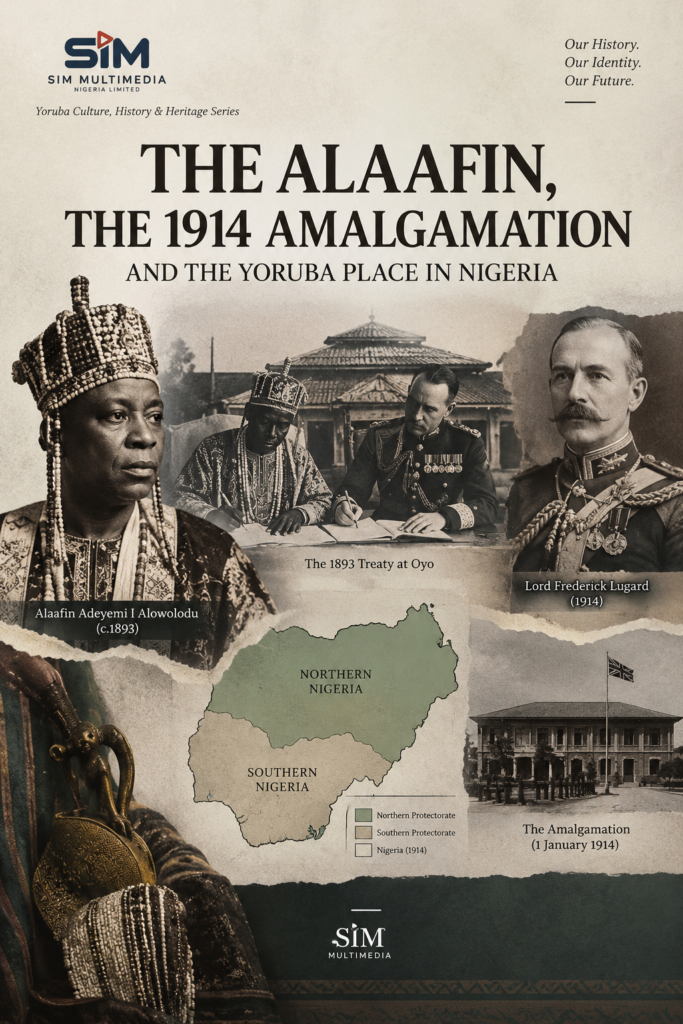
On 3 February 1893, Alaafin Adeyemi I Alowolodu signed a treaty with British Governor Gilbert Thomas Carter. The treaty identified the Alaafin as the ruler of Oyo and referred to him as the “Head of Yoruba-land.” Its provisions dealt with relations with Britain, trade, peace and territorial arrangements.
That wording is historically significant. It shows that Oyo was recognised as a political entity whose ruler negotiated directly with the British. It is evidence of the Alaafin’s standing in the diplomacy of that period.
The British subsequently extended their authority through further political interventions, and on 1 January 1914, Lord Lugard’s administration amalgamated Northern and Southern Nigeria under one government. The surviving official record identifies the amalgamation as a British administrative project.
Therefore, the strongest historical argument is not that the Alaafin single-handedly created Nigeria. It is that the history of Oyo and the Alaafin’s encounter with British colonial power formed part of the historical process through which Yoruba territories were incorporated into colonial Nigeria.
The Yoruba were not created by amalgamation. Their history, identity and political traditions predated the Nigerian state. What changed in 1914 was the colonial administrative structure governing their territories, alongside those of many other peoples.
The lesson is clear: Oyo’s historical importance should be defended with documentary evidence, not claims that the documents do not support. The 1893 treaty and the 1914 amalgamation are separate events, but together they help explain how an established Yoruba political world was transformed under British rule.