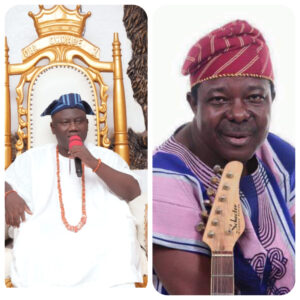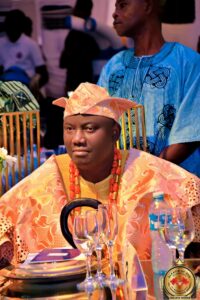

OYO — The coronation of His Imperial Majesty, Oba (Engr.) Abimbola Akeem Owoade I, the newly installed Alaafin of Oyo, continues to spark cultural discourse across Yorubaland and beyond. His carefully chosen regalia on the day of ascension was more than ceremonial display—it was a visual proclamation of power, history, and continuity.
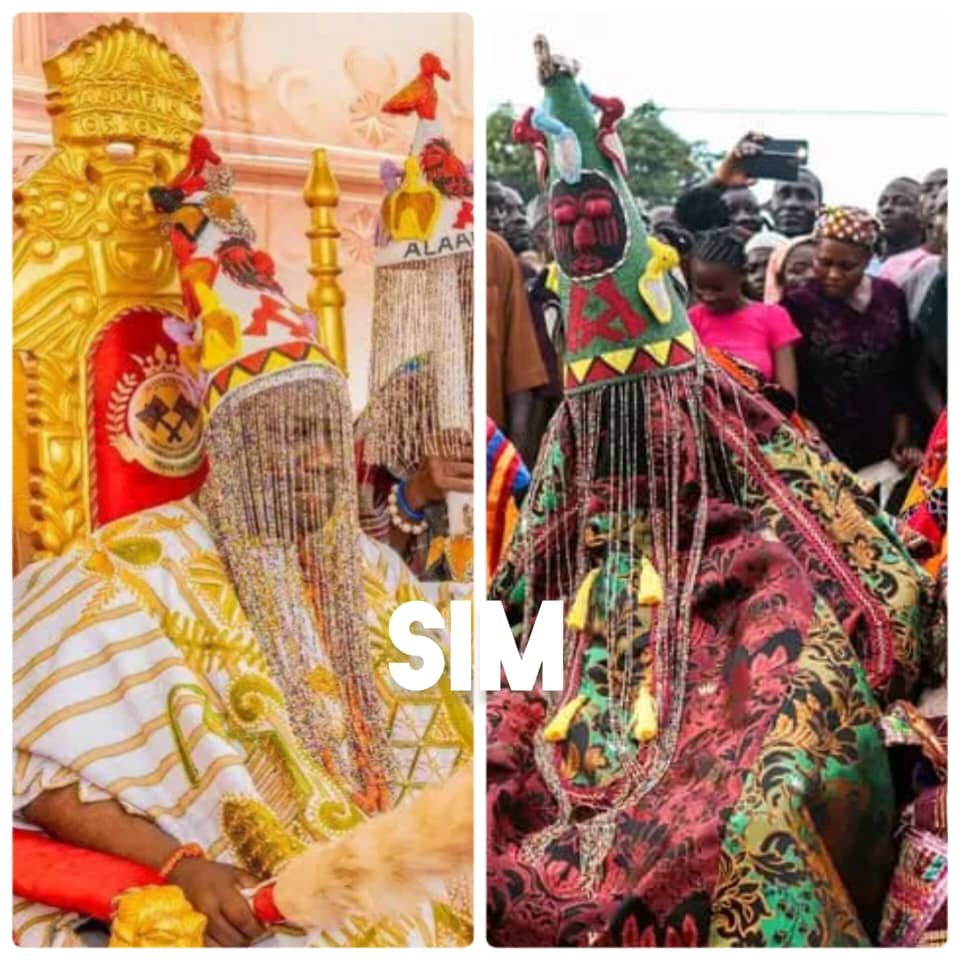
One detail that drew particular attention was the crown worn during his coronation. Observers and historians noted its striking resemblance to the Ege crown of Ota in Ogun State, a symbol deeply revered in Awori-Yoruba tradition.
Ege in Ota: The Crown of Supremacy
In Ota, the Ege masquerade reigns supreme as the Oba of all masquerades. Its annual Ege Festival remains one of the most culturally significant events among the Awori people. The Ege’s crown, often richly adorned and spiritually fortified, symbolizes absolute authority over all other masquerades within the region.
As noted by oral historian Chief J. O. Awoyemi and cultural scholar Prof. Wande Abimbola (1976), the Ege’s appearance is more than ritual pageantry—it is a reaffirmation of the sacred power (àṣẹ) bestowed upon Ota’s ancestral custodians. When the Ege steps out, all other masquerades must bow in deference; no performance begins until Ege has conferred his blessing.
This authority, expressed through the crown, has been preserved for centuries as a statement of divine and ancestral legitimacy.
Alaafin’s Crown: Symbol of Pan-Yoruba Authority
It is within this context that the Alaafin’s coronation crown takes on deeper meaning. Bearing resemblance to Ege’s, the Alaafin’s crown is not merely a fashion or artistic coincidence—it can be interpreted as a cultural message, reaffirming his traditional role as the sovereign symbol of Yoruba kingship.
In Yoruba political philosophy, the Alaafin of Oyo holds the ancient title “Oba tin f’oba je, Oba tin gb’adobale Oba” — “the King before whom other kings bow.” From the era of Oranmiyan, the founder of the Oyo dynasty, the Alaafin’s authority transcended geography, embodying both temporal and spiritual sovereignty across Yoruba polities.
Cultural historian Dr. Tunde Akinyemi describes Yoruba crowns as “living archives of history, woven in beads and prayers.” Each design, color, and symbol tells a story of lineage, legitimacy, and leadership—a communication between the seen and unseen.
Symbolic Diplomacy Between Oyo and Awori Traditions
The resemblance between the Alaafin’s crown and that of Ege in Ota can be seen as an artistic bridge—one that subtly reinforces the shared cosmological and cultural essence of Yoruba subgroups. While Ege’s crown denotes spiritual authority over the masquerade hierarchy, the Alaafin’s crown symbolizes imperial sovereignty over Yoruba kingship itself.
This convergence of symbolism underscores a timeless truth: though diverse in dialect and custom, the Yoruba people remain united by ancestral philosophy, sacred traditions, and the reverence for crown authority.
Conclusion
The Alaafin’s coronation crown is thus more than an artifact of royalty—it is a voice of heritage. Just as the Ege’s crown in Ota declares supremacy among masquerades, the Alaafin’s crown may subtly communicate the continuing ascendancy of Oyo’s spiritual and political heritage in Yoruba civilization.