


Colonialism did not simply introduce a new political administration into Yorubaland. It also altered the way traditional authority, law, taxation and local governance operated.
Before British colonial rule, Yoruba communities had established political systems with different structures depending on the kingdom or town. In places such as Oyo, authority was distributed among the Alaafin, Oyo Mesi, chiefs and other institutions, while other Yoruba communities operated through their own combinations of kingship, councils, lineage authorities and community leadership.
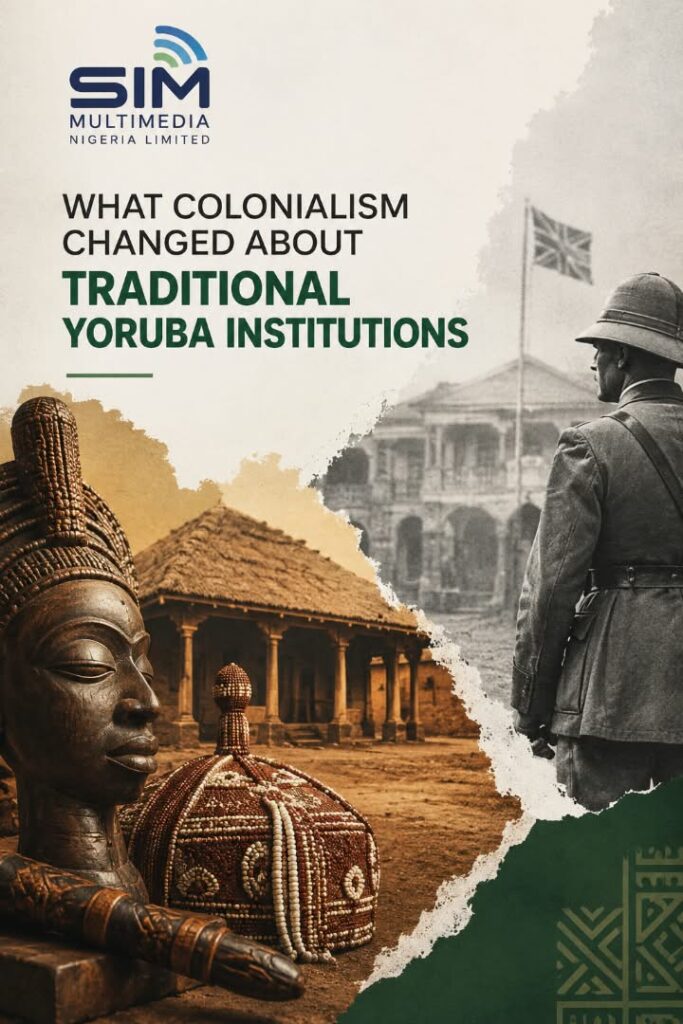
British administrators generally chose to govern through existing rulers where this was practical. This became associated with the policy of indirect rule. However, governing through traditional institutions did not mean leaving them unchanged. Colonial administration gradually redefined the powers and responsibilities of traditional rulers.
THE TRANSFORMATION OF TRADITIONAL AUTHORITY
One of the major changes was the incorporation of Yoruba monarchs and chiefs into the colonial administrative structure.
An Oba or chief who had previously derived authority primarily from indigenous political institutions now increasingly operated within a system supervised by British officials. Traditional rulers became important intermediaries between the colonial government and local communities, particularly in the collection of revenue and administration of local affairs.
Historical research on colonial Yorubaland describes this process as one that distorted and reconstructed existing chieftaincy structures, while Yoruba rulers and emerging Western-educated elites competed to define what traditional authority should mean under the new political order.
THE COURTS AND THE LAW
Colonial rule also changed the administration of justice.
Between 1904 and 1908, judicial agreements were concluded with a number of rulers in Yorubaland. These agreements facilitated the introduction of English legal principles and strengthened British control over criminal justice. According to historian O. Adewoye, the new arrangements challenged the sovereignty of Yoruba states and established the supremacy of English law over indigenous laws and customs in areas covered by the agreements.
Traditional institutions did not disappear overnight. Instead, indigenous practices continued alongside the emerging colonial legal system, but their authority was increasingly subject to colonial regulation.
TAXATION AND LOCAL GOVERNMENT
Colonial administration also gave traditional authorities new administrative responsibilities.
Native Authorities became part of a wider system through which local revenue was collected and certain government functions were performed. This transformed the relationship between rulers and their communities because authority became increasingly connected to formal administrative responsibilities, taxation and colonial government structures.
This was a significant departure from the precolonial political order, where legitimacy was rooted primarily in indigenous institutions, customs, lineage, political obligations and established traditions.
RELIGION, EDUCATION AND SOCIAL CHANGE
Colonialism also coincided with the expansion of Christian missionary education and Western-style schooling, particularly in southern Nigeria.
The emergence of a Western-educated Yoruba elite introduced new ideas about constitutional government, citizenship, representation, education and political rights. By the late colonial period, traditional rulers increasingly had to operate alongside educated political leaders and modern political organisations.
Thus, colonialism did not merely weaken traditional institutions; it placed them in competition and interaction with new forms of authority.
WHAT SURVIVED?
Despite these changes, Yoruba traditional institutions were not erased.
The institution of kingship survived. Obas, chiefs, Baales, traditional councils, festivals, customary practices and systems of cultural authority continued to play important roles in Yoruba communities.
What changed most significantly was the context in which traditional authority operated.
A ruler who once exercised authority principally within an indigenous political system now had to operate within a colonial—and later postcolonial—state.
That history explains an important feature of Yoruba society today: traditional institutions remain influential, but their constitutional and administrative powers are different from those they possessed before colonial rule.
THE HISTORICAL LESSON
Colonialism should therefore not be understood simply as a period when traditional Yoruba institutions were abolished.
It was more complicated.
Some institutions were weakened. Some were reorganised. Some were incorporated into colonial administration. Others survived by adapting to a changing political environment.
Understanding this transformation is essential to understanding the position of the Yoruba traditional institution in modern Nigeria.