

A Historical Examination of Oyo’s Political Institutions, Military Strength, Regional Influence and Enduring Legacy
INTRODUCTION: WAS THE OYO EMPIRE A HISTORICAL REALITY?
The existence of the Oyo Empire is not merely a claim preserved in Yoruba oral tradition. Its historical significance is examined in scholarly works documenting its political institutions, military organisation, relations with neighbouring states and role in the wider history of West Africa.
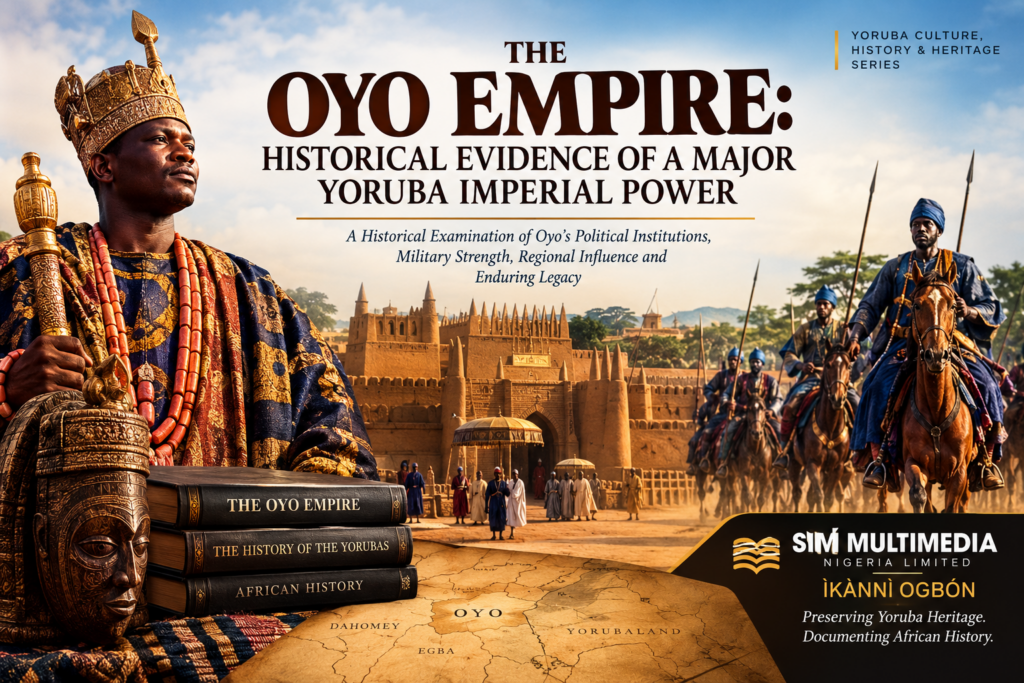
Although questions remain about the earliest origins of Oyo and the chronology of some traditional accounts, historians have established a substantial body of evidence concerning its development into a major regional power.
Among the most important scholarly works on this subject is Robin Law’s The Oyo Empire, c.1600–c.1836: A West African Imperialism in the Era of the Atlantic Slave Trade. Published by Clarendon Press in 1977, the book remains a foundational study of Oyo’s imperial expansion, political organisation, military strength and eventual decline.
The historical question, therefore, is not simply whether Oyo existed, but how it developed, exercised authority, influenced neighbouring societies and became one of the most significant political powers in the history of Yorubaland.
- ROBIN LAW AND THE DOCUMENTATION OF OYO’S IMPERIAL POWER
Robin Law’s research provides a detailed examination of Oyo as a state that developed beyond the boundaries of a single Yoruba settlement into a political power with influence over neighbouring territories.
His work investigates the relationship between Oyo’s internal political institutions, military capabilities, commercial interests and external relations.
The empire’s influence was not exercised through one uniform arrangement everywhere. Some territories experienced direct military pressure, while others maintained tributary relationships or negotiated political and commercial ties with Oyo.
This distinction is important. An empire is not defined only by the amount of land it directly administers. Its power can also be measured by its capacity to influence neighbouring rulers, demand tribute, intervene in regional affairs and protect or control important trade routes.
Oyo’s history provides evidence of these imperial characteristics.
- MILITARY STRENGTH AND THE EXPANSION OF OYO
Oyo’s military organisation was central to its rise as a regional power. Its army included cavalry, particularly important in the northern savanna and adjoining regions where horses could be deployed more effectively than in many densely forested areas farther south.
The use of cavalry gave Oyo military advantages in suitable terrain, although horses required substantial resources and were vulnerable to disease in some ecological zones.
In his article, A West African Cavalry State: The Kingdom of Oyo, Robin Law examines the significance of cavalry in Oyo’s political and military development.
Oyo’s military influence extended beyond its immediate Yoruba neighbours. Its conflicts and interactions with Dahomey are among the best-known examples of the empire’s involvement in the politics of the wider Bight of Benin region.
These encounters were not always straightforward or one-sided. Relations between Oyo and Dahomey included warfare, changing balances of power, diplomatic arrangements and tributary obligations during particular periods.
- OYO AND DAHOMEY: EVIDENCE OF REGIONAL INFLUENCE
The relationship between Oyo and Dahomey provides an important case study for understanding Oyo’s imperial reach.
During parts of the eighteenth century, Dahomey was subject to Oyo’s superior power and tributary demands. This relationship demonstrated that Oyo’s influence extended beyond the political boundaries of the Yoruba heartland.
However, the exact nature and duration of these arrangements changed over time. Dahomey retained its own political institutions and military capacity, and the relationship between the two powers was marked by negotiation, resistance and shifting circumstances.
The significance of this evidence lies in what it reveals about Oyo’s position in regional politics. Oyo was capable of exerting pressure on another kingdom, influencing its external relationships and extracting political or economic concessions.
Such relationships are recognised features of imperial power.
The history of Oyo and Dahomey also illustrates why the study of African empires must move beyond simplistic narratives. Regional powers could be dominant in one period and face serious challenges in another without their earlier achievements becoming historically irrelevant.
- OYO’S POLITICAL INSTITUTIONS AND GOVERNANCE
Oyo’s imperial strength was not based on military force alone. Its political institutions helped organise authority, manage elite relationships and sustain the kingdom’s system of government.
The Alaafin occupied the central royal position, while the Oyomesi served as an important council of senior political authorities. Other offices and institutions also contributed to the administration and political life of the state.
The relationship between the Alaafin and the Oyomesi was significant because it demonstrates that Oyo’s political system involved institutions, responsibilities and competing centres of authority rather than the unrestricted personal rule of a monarch.
The practical operation of these institutions changed over time, and historians continue to examine their powers, limitations and development.
Nevertheless, the evidence of Oyo’s political organisation challenges any suggestion that its imperial history can be understood solely through royal legends or accounts of individual rulers.
Oyo’s political development deserves examination as part of the wider history of African state formation and governance.
- TRIBUTE, TRADE AND THE EXERCISE OF IMPERIAL AUTHORITY
Oyo’s regional influence was sustained through a combination of military power, political relationships and economic interests.
Tributary arrangements provided one means of expressing the superiority of Oyo over certain neighbouring polities during particular periods. Trade and the movement of goods also formed part of the wider environment in which Oyo exercised power.
- THE DECLINE OF THE OYO EMPIRE
The decline of the Oyo Empire during the nineteenth century was a complex historical process involving internal political struggles, military challenges and changing regional conditions.
Political instability, disputes among powerful officeholders, provincial resistance and external pressures weakened the state’s ability to maintain its former authority.
The rebellion associated with Afonja of Ilorin and the growing independence of previously subordinate territories formed part of this wider process. The consequences extended beyond the old imperial centre, contributing to major political changes across Yorubaland.
The conventional historical chronology places the fall of Old Oyo around the 1830s, although the process of political disintegration developed over time rather than occurring in one simple event.
Robin Law’s later article, Making Sense of a Traditional Narrative: Political Disintegration in the Kingdom of Oyo, examines the challenges of interpreting traditional accounts of this period.
The decline of Oyo should not be mistaken for evidence that its earlier imperial power never existed. On the contrary, understanding how a state weakened requires historians to investigate the institutions, relationships and military capabilities that had previously sustained it.
The fall of an empire does not erase its history.
- ORAL TRADITION AND WRITTEN HISTORY: COMPLEMENTARY SOURCES
Yoruba oral traditions remain important sources for studying the origins, royal lineages, migrations and political memories associated with Oyo. Samuel Johnson’s The History of the Yorubas, published in 1921, is one of the most influential historical compilations drawing on Yoruba traditions.
However, oral traditions must be examined critically, just as written records must be assessed in light of their authorship, purpose, historical context and limitations.
European travel accounts, commercial records and other documentary evidence can provide additional information about Oyo’s relations with neighbouring states. Archaeological research and comparative historical analysis can also contribute to understanding settlement patterns and political development.
No single source answers every question. The strongest historical conclusions emerge when independent forms of evidence are compared and their limitations acknowledged.
- OYO’S PLACE IN YORUBA AND AFRICAN HISTORY
Oyo’s significance extends beyond the history of one royal dynasty or one geographical location. Its political institutions, military organisation, regional relationships and cultural legacy form part of the wider history of Yoruba civilisation and precolonial West Africa.
The empire’s development demonstrates that African societies built complex states, organised powerful military systems, negotiated relationships with neighbouring polities and influenced regional political and economic affairs.
Oyo should therefore be studied within its proper historical context—not through exaggerated claims, but also not through the dismissal of evidence because it concerns an African civilisation.
Recognising Oyo’s historical importance does not require diminishing the achievements of Ile-Ife, Benin, Dahomey or other African societies. Each had its own historical trajectory, institutions and cultural contributions.
- WHAT THE HISTORICAL EVIDENCE ACTUALLY ESTABLISHES
A responsible conclusion must separate well-supported historical findings from matters that remain uncertain or contested.
The scholarship on Oyo supports the following broad conclusions:
- Oyo developed into a major precolonial political and military power in West Africa.
- Its military organisation included cavalry, which contributed to its capabilities in suitable terrain.
- It exercised influence over neighbouring territories through warfare, diplomacy and tributary relationships during particular periods.
- Its political system included the Alaafin, the Oyo Mesi and other institutions involved in the exercise of authority.
- Its power weakened during a period of internal conflict and changing regional circumstances in the nineteenth century.
- Its imperial history is the subject of substantial historical scholarship, including the work of Robin Law and the influential compilation by Samuel Johnson.
These findings do not mean that every traditional account, royal chronology or territorial claim associated with Oyo has been conclusively verified. Historical scholarship requires individual claims to be assessed on their own evidence.
Nevertheless, uncertainty about particular details must not be confused with an absence of historical evidence.
CONCLUSION: THE EVIDENCE ESTABLISHES OYO’S PLACE IN HISTORY
Oyo’s imperial significance is demonstrated by its documented political institutions, military organisation, campaigns against Dahomey, tributary relationships with neighbouring states and influence over regional affairs. Robin Law’s studies of Oyo’s military and political history provide a substantial scholarly foundation for examining these developments and the empire’s eventual decline.
The historical case for Oyo rests on identifiable political institutions, military campaigns and regional relationships—not tradition alone.
Oyo’s place in history deserves recognition through evidence-based scholarship, responsible historical writing and the preservation of Yoruba heritage. Its story is an important part of the history of Yorubaland and precolonial Africa.
The objective is not to manufacture historical supremacy or diminish another civilisation. It is to ensure that Oyo’s achievements are examined honestly, its sources are treated critically and its contribution to African history is neither exaggerated nor unfairly overlooked.
SIM MULTIMEDIA NIGERIA LIMITED — ÌKÀNNÌ OGBÓN
Preserving Yoruba Heritage. Documenting African History.
SELECTED REFERENCES
- Law, Robin. (1977). The Oyo Empire, c.1600–c.1836: A West African Imperialism in the Era of the Atlantic Slave Trade. Oxford: Clarendon Press.
- Law, Robin. (1975). “A West African Cavalry State: The Kingdom of Oyo.” The Journal of African History, 16(1), 1–15. https://doi.org/10.1017/S0021853700014079
- Law, Robin. (1982). “Making Sense of a Traditional Narrative: Political Disintegration in the Kingdom of Oyo.” Cahiers d’Études Africaines, 22(87–88), 387–401. https://www.persee.fr/doc/cea_0008-0055_1982_num_22_87_3384
- Johnson, Samuel. (1921). The History of the Yorubas: From the Earliest Times to the Beginning of the British Protectorate. Edited by O. Johnson. London: George Routledge & Sons.
- Agiri, Babatunde A. (1975). “Early Oyo History Reconsidered.” History in Africa, 2, 1–16.
Editorial note
This article distinguishes established features of Oyo’s imperial history from questions that remain debated. Specific dates, individual campaigns and claims about the extent of Oyo’s authority should be checked against the relevant historical sources before being presented as definitive.